
+91 9895734005
Call us anytime
info@idealkerala.com
Drop us a line anytime!
+91 9895734005
Call us anytime
info@idealkerala.com
Drop us a line anytime!
At Ideal Ayurvedic Resort in Kovalam, abhyanga in panchakarma is the treatment almost every guest starts with, and it's also the one most people misread before they arrive. It looks like a spa massage from the outside. On the inside, it's doing a very specific job: loosening ama, the accumulated toxins Ayurveda holds responsible for disease, so the deeper cleansing stages of panchakarma can actually reach it.
Table of Contents
Panchakarma opens with a phase called Purva Karma, and its whole purpose is preparation. Two therapies carry that phase: snehana, or oleation, and swedana, the sweating or steam therapy that follows it. Abhyanga is the external half of snehana, with warm herbal oil massaged into the body from scalp to feet in a fixed sequence, while snehapanam handles the internal half through medicated ghee or oil taken by mouth.
The oil softens tissue and helps draw ama out of the deeper layers and toward the gastrointestinal tract, where it becomes reachable. Swedana, done right after, opens the channels further. Neither step removes toxins on its own. They move the problem into a position where the main procedures can finish the job. Skip this stage, or rush it, and the therapies that come next have far less to work with.
A single abhyanga session runs 45 to 60 minutes, and that number matters more inside panchakarma than outside it. When abhyanga is booked on its own, guests get the full-length version. When it's part of a supervised panchakarma detoxification program, the daily session is often shorter, because abhyanga is repeated for several consecutive days as groundwork rather than delivered once as the main event. Our physician sets the exact number of days after an initial consultation, based on constitution, current health, and what the rest of the program needs to accomplish.
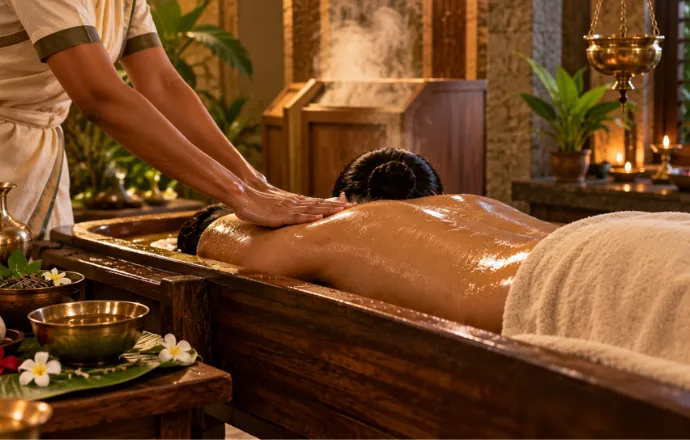
This is the part that gets flattened in a lot of marketing, so it's worth saying plainly. Abhyanga in panchakarma is preparatory. It is not Vamana, Virechana, Nasya, or Vasti, the five classical procedures that actually eliminate ama from the body once it has been mobilized. Calling abhyanga "the detox" misses what it's for. It gets the body ready for detox. The distinction matters for anyone deciding whether a short stay focused only on massage will deliver what a full panchakarma program is designed to do.
Once Purva Karma finishes, Pradhana Karma begins, and this is where the main procedures happen. Vamana addresses respiratory congestion tied to excess kapha. Virechana, a therapeutic purgation, is used when excess pitta shows up as skin flare-ups or digestive disturbance. Nasya works through the nasal passage for issues centered in the head, sinuses, and throat. Vasti, an herbal enema, is the primary approach for vata-related concerns such as joint pain, chronic constipation, and lower back complaints. Which of these a person receives, if any, is decided entirely by the physician after diagnosis. Abhyanga does not determine this on its own, and neither does the guest.
Abhyanga is generally well tolerated, but it is not appropriate for everyone at all times. Active fever, infection, indigestion, open wounds, or a recent injury are all reasons to postpone it. Pregnancy, recent surgery, cardiac conditions, uncontrolled diabetes, and blood-thinning medication all require clearance from a treating doctor first. This is standard practice, not caution for its own sake, and it reflects wider guidance from bodies such as the NIH's National Center for Complementary and Integrative Health, which advises disclosing any complementary therapy to your regular health care provider rather than using it in place of established care.
Abhyanga is a traditional wellness therapy, and while classical Ayurvedic texts describe a wide range of supportive uses, it is not a substitute for medical treatment and should never delay a diagnosis or prescribed care.
Abhyanga earns its place at the start of panchakarma because oleation has to happen before elimination can work properly. It's not a shortcut version of detox, and it isn't meant to replace the procedures that follow it. If you're weighing whether to book a single massage or commit to a full program, the honest answer depends on what your physician finds during consultation, not on which option sounds simpler. What's your main reason for considering panchakarma right now, general upkeep or a specific complaint you're hoping to address?
No, the difference is in the decision-making. A regular massage uses a standard oil and pressure for everyone. Abhyanga involves a physician choosing the oil, pressure, and sequence based on your constitution, which is also why it fits into a structured panchakarma plan rather than a spa menu.
Expect this to vary by person. Some programs use three to five days of oleation before moving to the main procedures; others need longer. Your physician decides based on your initial consultation, not a fixed template applied to every guest.
Not really. Picture the toxins sitting deep in tissue, stuck. Abhyanga and swedana loosen that grip and pull it toward the gut, where Vamana, Virechana, Nasya, or Vasti can actually clear it out. Jump straight to the main procedure without that groundwork, and you're working on toxins that haven't moved yet, so the result tends to be weaker.
Your physician reviews how you've responded over those days, checks your pulse and digestion, then picks the main procedure that matches your imbalance. Pitta issues showing up as skin flare-ups often lead to Virechana. Persistent joint pain or lower back trouble usually points toward Vasti. Nothing here follows a fixed script; it's decided case by case.
Pregnant guests, anyone recovering from surgery within the last few months, and people on blood thinners top the list. Fever, an open wound, or active infection are enough reason to wait too. We'd rather hear about a health condition at the enquiry stage than turn someone away at the door, so mention it early.