
+91 9895734005
Call us anytime
info@idealkerala.com
Drop us a line anytime!
+91 9895734005
Call us anytime
info@idealkerala.com
Drop us a line anytime!
At Chowara Beach in Kovalam, the day usually starts before the sun is fully up, with mats laid out facing the water and the tide setting the pace. Ayurvedic yoga brings together two systems that were never meant to be separate in the first place: the physical discipline of asana and the internal logic of Ayurveda, which reads the body through its doshas rather than just its muscles. Practiced together, they don't just improve flexibility or reduce stress in isolation. They work on the same problem from two directions at once.
Most people come to yoga first, usually for the physical benefits, and encounter Ayurveda later almost by accident. That order works fine, but it also explains why so many practitioners plateau. A vinyasa sequence built for a pitta-dominant body looks nothing like one suited to a vata constitution, yet standard yoga classes rarely make that distinction. Ayurveda fills that gap.
Table of Contents
| 1 | What Does Ayurveda Add to a Yoga Practice? |
| 2 | The Physical and Mental Case for Combining Them |
| 3 | Who Benefits Most From Ayurvedic Yoga? |
| 4 | Final Thoughts |
| 5 | FAQ |
Ayurveda's core idea is that every person carries a unique balance of vata, pitta, and kapha, and that imbalance in this balance shows up as fatigue, joint stiffness, poor digestion, or a restless mind, depending on which dosha is out of sync. A Panchakarma treatment addresses this at a deeper level than yoga alone can, using therapies like Abhyanga oil massage or Shirodhara to clear out accumulated toxins before the body is asked to hold a pose for any length of time.
This is where the sequencing matters. Doing deep detox work before a physical practice changes what the practice can achieve. Joints that were carrying inflammation move differently once the underlying imbalance has been addressed. Breathing that feels shallow because of digestive sluggishness often opens up on its own, without anyone having to correct the posture.
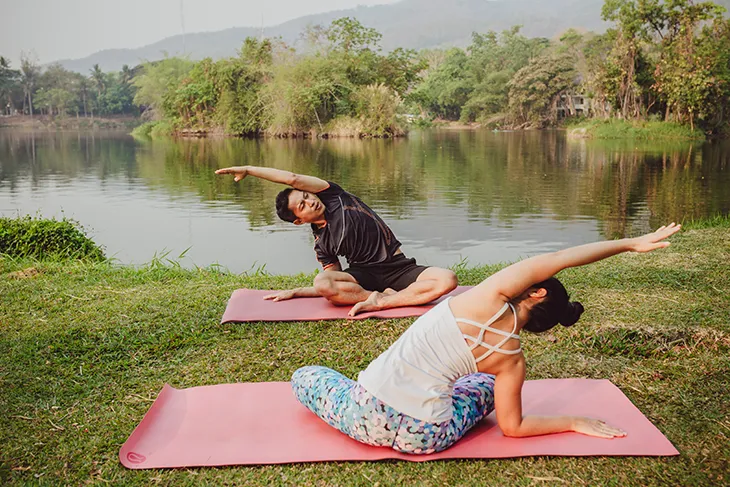
At Ideal Ayurvedic Resort, yoga sessions are built around this understanding rather than treating it as an add-on. Classes are structured for beginner, intermediate, and advanced practitioners, and instructors trained in traditional asana also draw on Ayurvedic principles when adjusting a sequence for someone recovering from a Panchakarma protocol versus someone building general fitness. The two disciplines are taught as one continuous system, not as a morning class followed by an unrelated afternoon massage.
Yoga on its own asks the nervous system to slow down through breath control and sustained postures. Ayurveda approaches the same nervous system through diet, oil therapy, and daily routine, or dinacharya. When both are applied together, recovery from stress tends to hold longer, because the body isn't just calming down for the length of a session. It's being supported by everything eaten and applied to the skin in the hours around that session too.
There's a practical reason this matters for people traveling specifically for wellness. A short yoga retreat without any Ayurvedic component gives a temporary reset. Add treatments like Shirodhara or Udwarthana powder massage into the same week, and the nervous system has less to fight against once the retreat ends and ordinary life resumes.
People managing chronic stress, poor sleep, or recurring joint pain tend to notice the difference fastest, since these are exactly the conditions where dosha imbalance shows up first. According to research summarized by the National Center for Complementary and Integrative Health, Ayurvedic approaches are most often used alongside conventional care for exactly these kinds of chronic, stress-linked conditions rather than as a standalone replacement for medical treatment. That framing matters. Ayurvedic yoga works best as a supportive, informational practice, not a cure, and any resort presenting it otherwise is overstating what the tradition claims for itself.
Beginners often assume they need years of yoga experience before Ayurveda becomes relevant. In practice, the opposite tends to be true. Starting both together means the physical practice is calibrated to the body's actual state from day one, instead of a generic sequence being adjusted later once problems surface. This mirrors the broader Ayurvedic treatment packages offered at the resort, which structure every stay around the guest's constitution from the start.
Separating yoga from Ayurveda is mostly a modern habit, not a traditional one. The two developed side by side in Kerala for centuries precisely because neither fully addresses what the other is built for. Anyone considering a wellness retreat might ask a simpler question before booking: does the program treat yoga and Ayurveda as one system, or as two separate bookings on the same itinerary?
Yes, and it's arguably a better starting point than a standard studio class. Instructors assess dosha type first, so beginners get a sequence matched to their body rather than a one-size-fits-all routine borrowed from a general fitness class.
Most guests report changes in sleep and digestion within the first week, especially if Panchakarma treatments run alongside the yoga sessions. Deeper structural changes, like joint mobility or long-term stress resilience, usually need a longer stay of ten days or more.
Meals are typically adjusted to your dosha rather than following one universal restrictive diet. Someone with a pitta imbalance eats differently from someone with a vata imbalance, even on the same retreat, in the same week.
It can support management of these conditions alongside conventional medical care, though it isn't positioned as a replacement for that care. Treatments like Kizhi or Pizhichil are often used to ease joint stiffness, while breathwork and Shirodhara support the nervous system.
Check whether instructors distinguish between dosha types when structuring classes and whether Panchakarma or other treatments are integrated into the schedule rather than sold as separate spa add-ons. A program built around one continuous system usually explains this clearly before you arrive.