
+91 9895734005
Call us anytime
info@idealkerala.com
Drop us a line anytime!
+91 9895734005
Call us anytime
info@idealkerala.com
Drop us a line anytime!
Everyone's heard of Ashwagandha. It's the herb that shows up on every wellness list, in every supplement stack, and on every influencer's kitchen counter. But if Ashwagandha is the only tool you know for stress, you're working with a very small toolkit. Ayurveda has been addressing anxiety and mental fatigue for over 3,000 years. And the tradition didn't build that track record on one herb. The best Ayurvedic medicine for stress and anxiety is rarely a single plant. It's a considered combination of herbs, therapies, and lifestyle shifts matched to your specific constitution.
Here's what the full picture actually looks like.
Table of Contents
Most modern approaches treat stress as a purely mental event. Ayurveda treats it as a full-body imbalance. Specifically, chronic stress is understood as an aggravation of Vata dosha, the energy that governs movement, the nervous system, and the mind.
When Vata spins out of control, you get scattered thinking, poor sleep, digestive trouble, and that constant background hum of worry. Fixing it isn't just about calming the brain. It's about grounding the entire system.
That distinction matters a lot when you're choosing what to take or do.
Brahmi is arguably the most respected herb for mental health in the classical Ayurvedic texts. Where Ashwagandha works more on physical resilience and energy, Brahmi targets the mind directly. It has traditionally been used to support clarity, improve retention, and quieten anxious mental chatter. It's often taken as a warm tea or as medicated oil applied to the scalp, and at Ideal Ayurvedic Resort, Brahmi-based oils are used in several of the signature treatments for nervous system support.
It's often taken as a warm tea or as medicated oil applied to the scalp, and at Ideal Ayurvedic Resort, Brahmi-based oils are used in several of the signature treatments for nervous system support.
Less famous than Ashwagandha but deeply respected by Ayurvedic physicians, Jatamansi is the herb practitioners reach for when anxiety is disrupting sleep. It works on calming an overactive mind and is particularly suited to Vata-dominant conditions. Think of it as the quieting herb, the one that tells your nervous system it's allowed to rest.
Shatavari is better known as a women's health herb, but its role in stress management deserves more attention. It's cooling, nourishing, and especially useful when anxiety presents alongside exhaustion or burnout. When someone is running on empty and still feeling wired, Shatavari is often part of the answer.
Herbs alone are rarely the complete answer. The classical texts always paired internal remedies with external therapies, and two stand out for stress and anxiety specifically.
Shirodhara is the therapy where warm herbal oil is poured in a continuous, thin stream over the forehead. It sounds simple. The experience is far from it.
The effect on the nervous system is deeply calming. Many people describe the experience as the first time in months they've actually felt their mind stop. It's one of the signature treatments at Ideal Ayurvedic Resort in Kovalam, and it's offered as part of structured wellness packages rather than as a single session, which is how it should be done.
Abhyanga is the practice of full-body warm oil massage, typically using Brahmi- or Ashwagandha-infused oils. It's far more than a relaxation treatment. The oil penetrates the skin, the rhythmic strokes calm the nervous system, and the sustained warmth helps ground an elevated Vata. Done consistently, it shifts the body's baseline state.
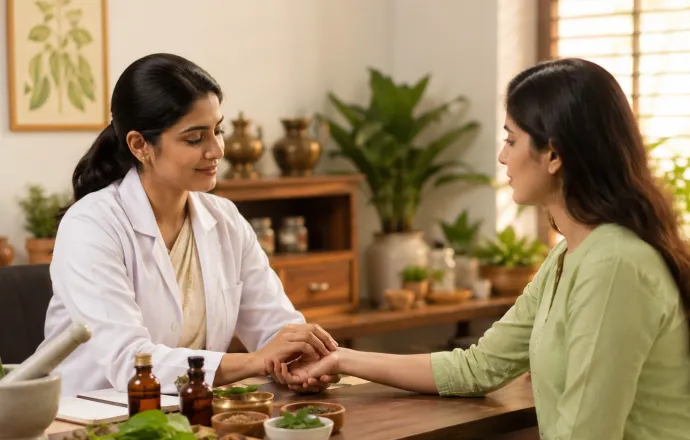
Ayurveda is firm on this: you can't herb your way out of a chaotic lifestyle. Diet and daily routine (called dinacharya) are considered as important as any medicine.
For Vata pacification, warm, moist, easily digestible foods are the foundation. Warm soup, cooked vegetables, ghee, and root vegetables. Caffeine and cold foods tend to spike Vata further. Regular sleep and wake times are non-negotiable. The nervous system regulates itself partly through consistency.
Pranayama, specifically alternate nostril breathing (Nadi Shodhana), is another tool that's free, takes under ten minutes, and has a measurable effect on the parasympathetic nervous system.
Ashwagandha is a genuinely good herb. Nobody is disputing that. But anxiety and chronic stress are complex. They involve the nervous system, sleep, digestion, thought patterns, and daily habits all at once. The best Ayurvedic medicine for stress and anxiety isn't a single capsule you add to your morning routine. It's a framework that treats the whole person.
If you're dealing with stress that isn't responding to the usual fixes, it might be time to look at what traditional Ayurveda actually recommends in full, not just the parts that made it onto mainstream wellness shelves.
What aspect of stress are you finding hardest to manage right now: sleep, focus, or just that constant low-level tension?
It depends on what kind of anxiety you're dealing with. Ashwagandha is better when stress is physical, when you're exhausted, low-energy, and burnt out. Brahmi is stronger for mental anxiety, racing thoughts, and concentration issues. Many Ayurvedic practitioners use both together, but they're not interchangeable.
Most people say it's like nothing they've experienced before. The warm oil flowing over your forehead creates this unusual, deeply sedating calm. A lot of people fall asleep on the table. It's used specifically for anxiety, insomnia, and mental fatigue in Ayurvedic settings.
No, and it's important to be clear about this. Ayurvedic herbs and therapies are traditional wellness tools. If you're on medication for anxiety or have a diagnosed anxiety disorder, always speak to your doctor before making changes. Ayurveda works well as a complementary support system, not a standalone medical treatment.
Honest answer: it varies. Shirodhara often has an immediate calming effect. Herbs like Brahmi and Jatamansi typically take two to four weeks of consistent use before you notice real shifts. The lifestyle changes, sleep routine, and diet adjustments, take longer but tend to create the most lasting difference.
Vata governs the nervous system in Ayurveda. When it's aggravated, the nervous system is basically running too hot. You get scattered thinking, light sleep, tension, and worry. Almost all Ayurvedic stress management is built around grounding Vata, which is why warm oils, warm foods, and calming herbs like Jatamansi are so central to the approach.