
+91 9895734005
Call us anytime
info@idealkerala.com
Drop us a line anytime!
+91 9895734005
Call us anytime
info@idealkerala.com
Drop us a line anytime!
At Ideal Ayurvedic Resort in Kovalam, the oil used for Pizhichil is never poured before a guest has been examined. Vaidyar J. Christudas checks prakriti and the dosha imbalance he finds first, then decides what goes into the formula. That single step is what separates a physician-supervised Pizhichil course from a spa treatment that has simply borrowed the name.
Table of Contents
Pizhichil brings together two classical processes: Snehana, or oleation, and Swedana, sudation through warmth. Many Kerala families still call it Thailadhara. It's one of the older therapies practiced in largely the same form for generations, usually reserved for stiffness, joint pain, and nerve-related complaints rather than a quick relaxation hour.
At consultation, the physician notes your constitution and current condition, then builds a plan from there. No two guests get an identical prescription. The base oil, the herbal additions, and even the warmth of the pour are matched to what the doctor finds, not to a fixed house recipe. This is standard practice for Snehana therapies.
The resort prepares its herbal oils in-house or sources them from Kerala manufacturers it has worked with for years. Formula, herbs, and base are chosen for the guest's dosha pattern and warmed fresh before each session. Nothing sits pre-mixed on a shelf waiting for the next booking.
During the treatment itself, you lie on a wooden droni, the traditional treatment table. A cloth band is tied across the forehead, partly to keep oil out of the eyes and partly to keep the head cool while the body is warmed. Cotton cloths dipped in the lukewarm oil are squeezed over the body in a steady stream, and two to four therapists follow the pour with long, coordinated strokes. The therapy moves through seven set positions so nothing below the neck is missed.
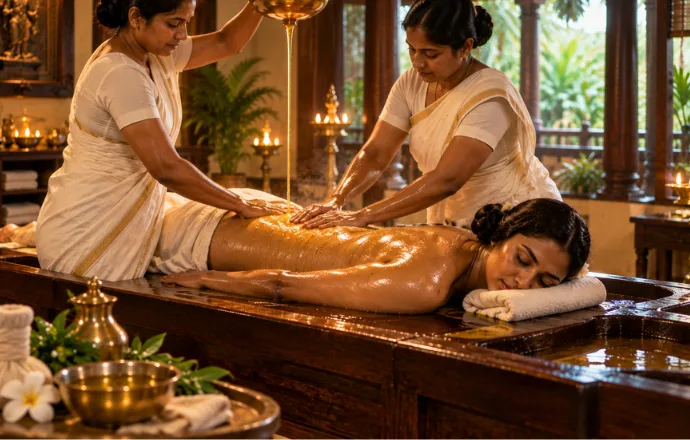
Oil is warmed fresh every day of a course and never carried over from a previous session. A physician stays available through the program to adjust temperature, pressure, or the oil itself if your response over the first few days suggests a change is needed. That flexibility matters because a single session, at 45 to 60 minutes, is only part of the picture. Most physicians recommend a course of 7 to 14 consecutive days, since Ayurveda treats this therapy as cumulative rather than a one-time fix.
Conditions traditionally supported by Pizhichil include arthritis and joint stiffness, sciatica, muscle spasm, general rheumatic pain, nervous exhaustion, and disturbed sleep. For psoriasis and eczema, the oil is chosen for the skin's dryness and itching rather than for joints. High blood pressure is treated as an area where Pizhichil sits alongside a doctor's existing prescription, never in place of it. None of this makes Pizhichil a cure. Ayurveda describes it as supportive therapy, and any claim beyond that should raise a flag before you book.
Guests often confuse the three. Pizhichil covers the body below the neck with continuously poured oil and simultaneous massage from several therapists, making it the heaviest of the three and the one most often prescribed for joints and nerves.Shirodhara Ayurvedic treatmen t works only on the forehead, using a thinner stream with almost no massage, and is chosen for stress and sleep issues. Abhyanga applies oil by hand rather than pouring it, without the sustained heat, and often works as a gentler entry point or a preparation step before Pizhichil begins.
Choosing the right oil used for Pizhichil isn't something a guest decides from a treatment menu. It comes out of an examination, gets adjusted through a course, and depends on what the physician sees change day by day. If you're weighing this therapy for a joint, nerve, or muscle complaint, the more useful question isn't which oil is best. It's which physician is actually examining you before any oil touches your skin. What would you want your consultation to cover before committing to a full course?
No. The physician examines your constitution and current condition first, then chooses the base oil, herbs, and warmth from there. Two guests booked on the same day can walk out with different formulas, because the oil is built around what the doctor finds, not a fixed menu item.
It comes down to prakriti and the dosha imbalance found at consultation. Joint and nerve complaints usually call for a different formula than skin conditions like psoriasis or eczema, where the oil is chosen to calm dryness and itching rather than to ease stiffness.
Yes, and it often does. A physician stays available through the program, so if your response over the first few days points to too much heat or the wrong formula, the oil, pressure, or temperature can be adjusted before the course continues.
It varies by design. Ayurveda treats oil selection as personal to the patient rather than universal to the treatment. That's part of why a real consultation matters more than the marketing on a resort's treatment page.
Tell the therapist or physician the same day. Skin irritation from an oil ingredient is one of the possible mild effects of Pizhichil, and it's exactly the reason formulas are built after consultation rather than handed out by default.