
+91 9895734005
Call us anytime
info@idealkerala.com
Drop us a line anytime!
+91 9895734005
Call us anytime
info@idealkerala.com
Drop us a line anytime!
A full panchakarma course usually needs at least fourteen days, and for most of that time your plate is part of the treatment. That makes a panchakarma diet very different from a detox list pulled off the internet. It shifts as the program moves, and a doctor sets it after seeing you in person. Here is how food fits into each stage, and what to ask before you begin.
Before treatment, preparation comes from oil-based therapies and sweating. During the main procedures, a physician adjusts meals as the course advances. Afterward, eating moves slowly from liquid preparations to solid food.
Table of Contents
Panchakarma means five actions. In practice, that's five procedures done one after another, not a single treatment. Your body needs different things at different points, so your meals change too.
Texts name the three phases Purva Karma, Pradhana Karma and Paschat Karma. Preparation, the main procedures and recovery each put a different load on digestion, so meals change with them. The recovery phase, for instance, begins with liquid preparations and moves toward solid food. Your dosha, your digestion and the physician's daily assessment decide the finer points, which is why two people on the same course can end up eating differently.
Here is the honest answer. There is no universal pre-treatment menu.
The preparation stage rests on two therapies. Snehana is oleation, where medicated oil or ghee is applied to the body, and ghee is also taken internally in some programs. Swedana is sweating, which usually follows and softens the tissues further. Snehapanam, the intake of medicated ghee in slowly rising doses each morning, is one way this preparation happens.
Since the doctor decides these steps, your homework before arrival is simple. Write down what you normally eat. List every medicine you take. Carry recent reports and prescriptions. A physician who knows your routine can plan a sensible panchakarma cleanse diet around it instead of guessing.
Pradhana Karma is the core of the course. It includes Vamana, which is therapeutic emesis, Virechana, purgation with an herbal laxative, and Basti, a medicated enema. Nasya, the nasal administration of medicine, and Raktha Mokshana, therapeutic bloodletting, complete the five. Raktha Mokshana is less commonly practiced. Which ones you receive depends on your dosha and your condition. Vamana is linked to Kapha conditions, Virechana to Pitta, and Basti to Vata.
Procedures like these change how digestion behaves, so meals are adjusted in step. During this stage, diet is treated as part of the medicine itself. At a Kerala centre that follows the classical format, an individual Ayurveda diet menu is composed for each guest, meals are vegetarian, and the kitchen changes what reaches the table as the course advances. Daily consultations give the doctor room to tweak things as your body responds.
The last stage is where people get impatient. After the main procedures, digestive capacity needs rebuilding. Paschat Karma therefore begins with a planned regimen that starts with more liquid preparations and gradually increases to solid food. The goal is to restore normal digestion, not to be back at your usual dinner table on day one.
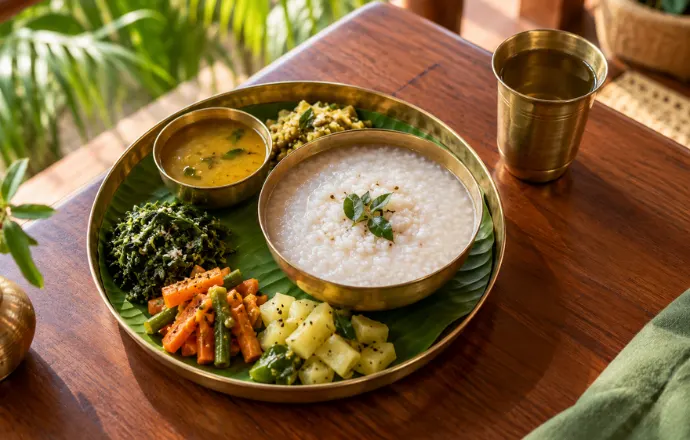
That sequence sits at the heart of any diet after panchakarma. Anyone hunting for a printable panchakarma diet chart will find the principle rather than a recipe list. The order matters more than the exact dishes. Rasayana therapy is often recommended at this point to nourish the tissues, support immunity, and refresh the body and mind.
Panchakarma is a structured medical-style program, not a wellness trend. Some procedures are not advised during pregnancy or with certain conditions, and the first consultation exists to sort that out. Older guests can be treated too, since many therapies can be adapted.
Tell the doctor about any long-standing condition. Keep taking prescribed medicine unless your own doctor says otherwise. Ayurveda is often used alongside conventional care, results differ from person to person, and no outcome can be promised.
Food during Panchakarma works like a sequence, not a list. Prepare, adjust, then rebuild slowly. The physician fills in the details, and your part is giving them an accurate picture. The stage descriptions here draw on educational material from Ideal Ayurvedic Resort, a Kerala centre that has offered Panchakarma since 1997.
So what does your current eating routine look like, and have you written it down for your doctor yet?
Not straight away. Digestion needs time to recover, so the plan starts with liquid preparations and moves toward solid food step by step. Your physician sets the pace. Jumping to heavy meals skips the gradual progression the whole course is built around.
Often, yes. At the Kerala centre referenced here, meals are vegetarian and cooked to suit your treatment. Rules differ between centres, so ask yours before you travel. The doctor may also adapt the menu to your dosha and condition..
Most programs run seven to twenty-one days. Panchakarma itself generally needs at least fourteen, while shorter programs suit things like stress-related care. The doctor recommends a length after your consultation, and shorter stays are possible if your schedule demands it.
Reports vary widely from guest to guest. Some notice calmer sleep within the first few sessions, others take longer, and a portion feel little change at all. Ayurvedic tradition treats abhyanga as a cumulative practice rather than a single fix, which is part of why longer residential programmes are structured the way they are.